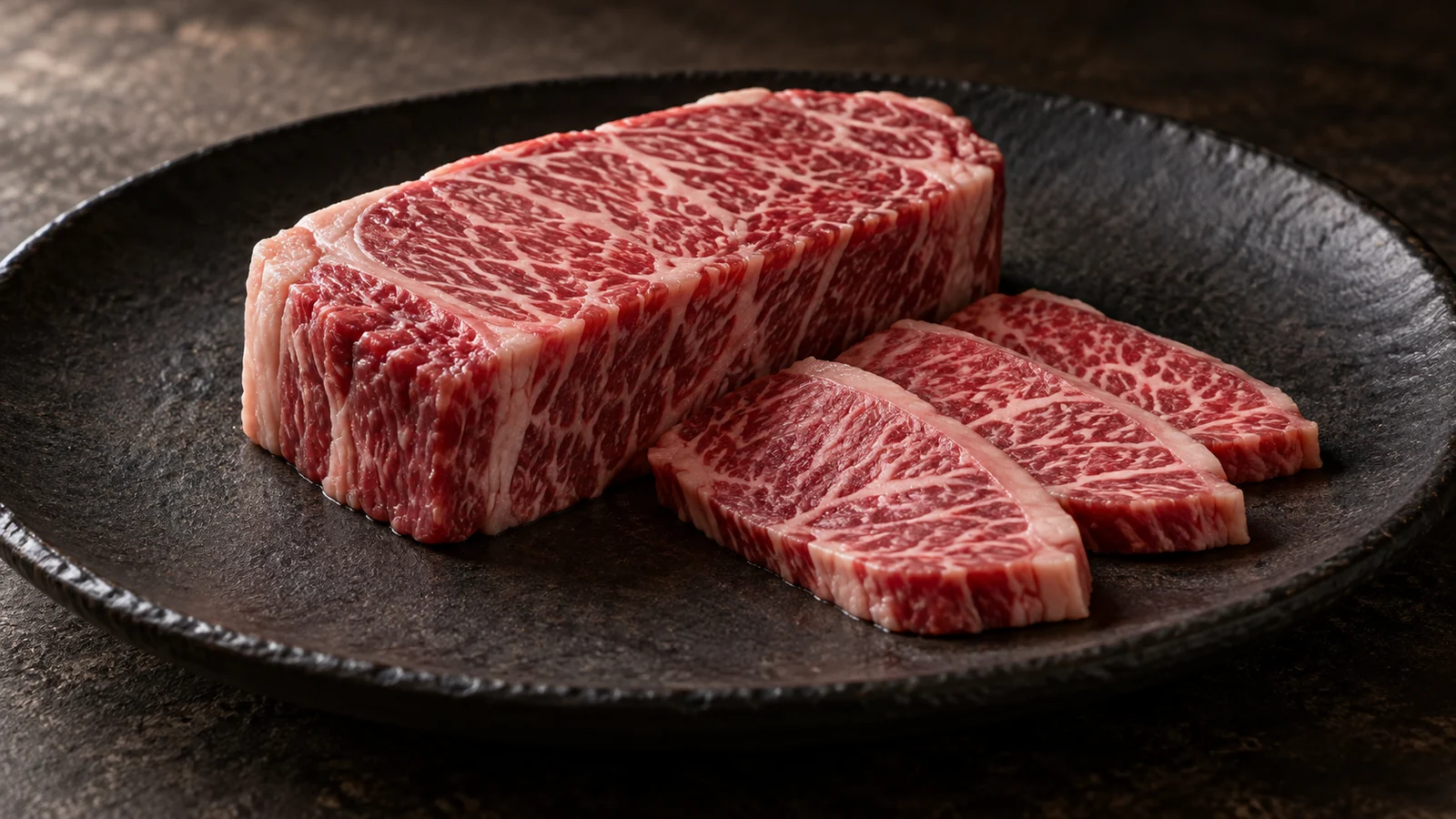
Opening image: AI-generated editorial illustration.
Imagine opening a menu and finding beef threaded with fine white veins. Beside the photograph are three names: Wagyu, Kobe and A5. Do they describe the same animal, or tell you different things? Understanding them is the first step towards choosing.
Those white veins are fat distributed within the muscle: marbling, also known as intramuscular fat. Yet the story begins long before the beef reaches the plate. It involves animals that worked in the fields, selective breeding and different ways of cutting, cooking and eating.
And it holds a surprise: not every wagyu breed matches the image of intensely marbled beef that has become so famous.
Before culinary prestige, there was work in the fields
The ancestors of wagyu were used for agricultural work and transport for a long time. During the Meiji era, which began in 1868, Japan brought in foreign cattle and carried out crossbreeding that helped shape today’s breeds. Their history includes exchanges and selection; their genetics have not remained unchanged for millennia.
Farm mechanisation later changed the role of these animals. During the 1960s, beef production became increasingly important compared with draught work. The evaluation of meat traits, including marbling, also developed. History of wagyu breeding, Kyoto University.
The table changed too. Japan’s agriculture ministry explains that meat consumption spread as the country opened up and that restaurants serving beef hot pots became popular in cities. One common simplification is worth avoiding: historical restrictions do not mean that nobody ate meat before the Meiji era. Japan’s food history, MAFF.
The four wagyu breeds
Wagyu encompasses four Japanese breeds and, within the Japanese definition, crosses between them. Saying ‘it is wagyu’ therefore leaves plenty still to discover. MAFF definition.
| Breed | What to remember |
|---|---|
| Japanese Black | The most widespread breed and particularly associated with intense marbling. Its Japanese name is Kuroge Washu. |
| Japanese Brown | Also known as akaushi. Its Kumamoto and Kōchi lines reveal different profiles within wagyu. |
| Japanese Shorthorn | Associated with north-eastern Japan. Iwate is a key region, with a history linked to grazing. |
| Japanese Polled | Associated with Yamaguchi. ‘Polled’ means naturally hornless; this is another branch of wagyu with a greater emphasis on lean meat. |
Japanese Black attracts much of the commercial attention, but looking at the other three changes our idea of what Japanese beef can be. The Japan Meat Information Service Center describes differences between their profiles, without suggesting that every animal and cut will taste the same. The four breeds, JMI.
In Kumamoto, for example, the official registration of Kumamoto Akaushi links the selection of Japanese Brown cattle to adaptation to grazing in Aso and beef in which lean meat remains prominent alongside marbling. This is not a promise that applies to every product bearing the word akaushi. Kumamoto Akaushi registration, MAFF.
The Japanese Shorthorn offers another trail to follow: the former Nanbu transport cattle, crosses with Shorthorn and rearing in the north-east. Iwate Prefecture describes systems in which cows and their calves use pasture. That landscape is part of wagyu too. Iwate’s Japanese Shorthorn cattle.
Kobe and Tajima: two names with different meanings
Within Japanese Black cattle there is Tajima, a lineage associated with Hyōgo. Kobe, by contrast, identifies certified beef that must meet specific conditions for ancestry, rearing, processing and grading. It is not a fifth breed.
Among other requirements, the official Kobe specification sets eligible categories of Tajima cattle and carcass criteria. The carcass is the animal’s body after slaughter and preparation for cutting. The specification accepts yield grade A or B and quality grade 4 or 5, with a specified minimum level of marbling. This clears up another confusion: Kobe does not necessarily mean A5, and finding A5 on a label does not establish that the beef is Kobe. Official Kobe specification, updated in April 2026.
Japan also has other brands with their own rules. Matsusaka, associated with Mie, requires female Japanese Black cattle that have not calved, along with registration and finishing conditions. Ōmi is linked to Shiga. These names tell regional stories; they are neither a list of breeds nor a universal ranking of flavour. Matsusaka definition and Ōmi registration.
What A5 means, simply explained
Japanese carcass grading combines two pieces of information. The letter A, B or C indicates the estimated yield of usable meat. The number from 1 to 5 assesses quality in four areas: marbling, meat colour and brightness, firmness and texture, and fat characteristics.
The final quality grade depends on the lowest-scoring area. It is not an average. BMS, meanwhile, is the specific marbling scale and runs from 1 to 12. These measures are related, but they are not interchangeable. Grading standard, JMGA.
For the person eating, the implication is straightforward: A5 provides information, but it does not choose your meal for you. You still need to know the cut, how much fat you would enjoy and how you will prepare it. Nor does a carcass grade amount to animal welfare certification in its own right.
The care behind the beef
Care in cattle farming is easier to understand through specific tasks. Japanese cattle guidelines cover suitable feed and water, observation of animals, health care and housing conditions. These are management guidelines; understanding how they are applied means looking at the practices of each farm. Cattle management guidelines, MAFF.
What about beer, massages or music? The answer has more nuance than the legend. The Kobe association explains that these are not general production requirements. Matsusaka’s municipal website does describe beer and massage practices in some rearing systems. The existence of a practice does not establish that it causes marbling or applies to all wagyu. Kobe FAQ and cattle rearing in Matsusaka.
Feeding deserves a question of its own: what the animal receives and during which stages. Our guide to grass-fed or grain-fed beef explains how to read that information without attributing the entire result to a single factor.
From animal to plate: three ways to look at a cut
Now think about how the beef reaches the table. A thick steak and a thin slice offer different experiences. Some Japanese preparations show how the cut and thickness are part of the dish:
- Sukiyaki: sliced beef with ingredients such as vegetables and tofu, in a sweet and savoury preparation. The order and method of cooking vary regionally.
- Shabu-shabu: very thin slices cooked in broth and served with sauces.
- Yakiniku: small pieces grilled, often at the table, allowing diners to alternate between cuts.
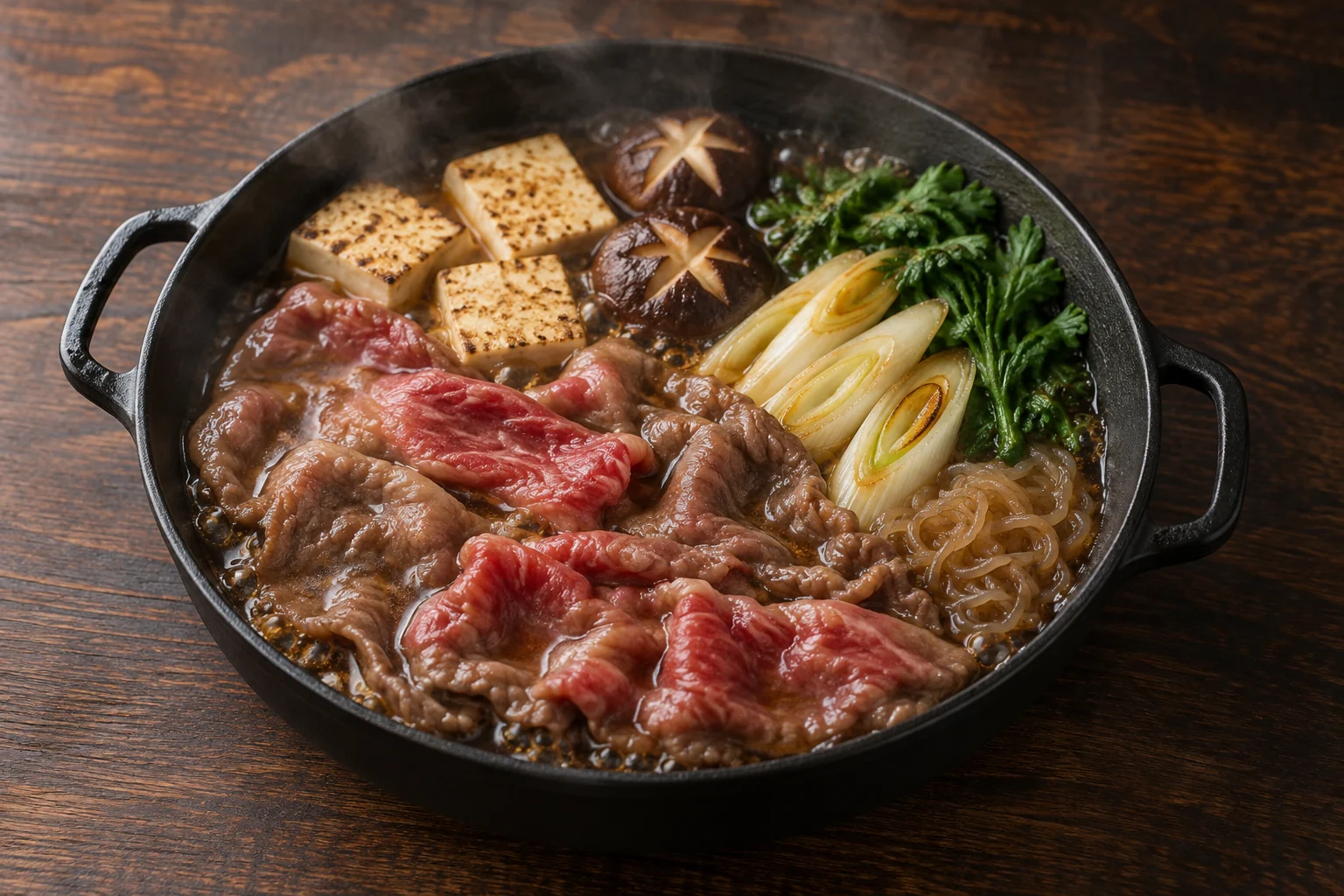
Even a single dish can follow different paths. In many Kantō households, sukiyaki begins by heating the seasoning mixture before adding beef and vegetables. In Kansai, cooking the beef usually comes first. MAFF notes that some traditional Tokyo restaurants also follow this second approach. Japanese cooking has regional and family differences that no single recipe can capture.
Sources: Tokyo sukiyaki, MAFF, Washoku guide, page 30 and yakiniku, JNTO.
These preparations are not exclusive to wagyu, nor do they make every cut interchangeable. They offer another way to choose: start with the dish and ask for a suitable cut and thickness. A prestigious name on the label becomes useful when you know what you will do with the beef.
When Japanese genetics travel
You can also find wagyu reared outside Japan. Australia has cattle with wagyu ancestry and crosses with other breeds, such as Angus. Its register distinguishes fullblood and purebred: the two terms do not mean the same thing. The first requires registered ancestry without crossing with other breeds; the second can result from successive crosses. Read each category within the system that supports it. Australian Wagyu Association.
Japanese genetics, Spanish rearing
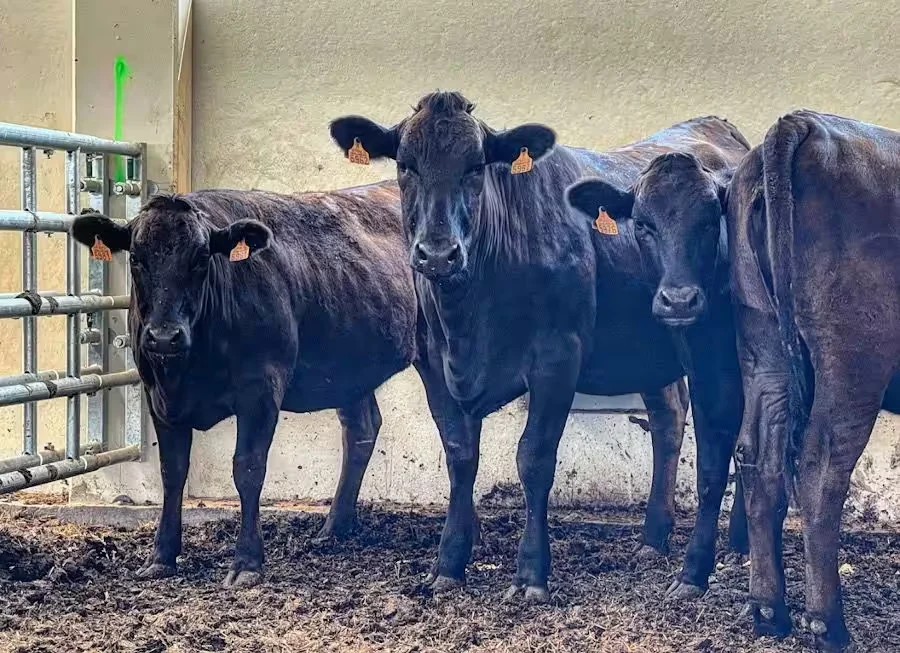
There is an example closer to home in Spain. Discarlux presents Ushido, in collaboration with Herencia Wagyu, as a project using Japanese Black/Tajima genetics, with animals born, reared and slaughtered in Spain. This supplier description illustrates the distinction: Japanese ancestry and Spanish origin can coexist. That does not make the beef Kobe.
Carnes Deluxe has a commercial collaboration with Discarlux. Read our editorial transparency policy.
Four questions to help you choose
Back at that menu, you can now put the information in order. Wagyu describes the cattle; Kobe, a specific certification; A5, a grade. Before deciding, ask:
- Where was the animal reared, and what ancestry is stated?
- What documentation supports the brand or grade being advertised?
- Which cut will I receive, and how is it presented?
- Which preparation suits this cut and my preferences?
Japan has an individual identification system that lets you look up information about an animal. That record and a brand’s certification serve different purposes: a number alone does not establish that a piece of beef is Kobe. Cattle traceability, MAFF.
Perhaps next time you will choose heavily marbled beef. Or perhaps you will be curious to discover a Japanese breed with more emphasis on lean meat. Either way, you will have moved from recognising a name to understanding a choice. And that is where a good meal begins.