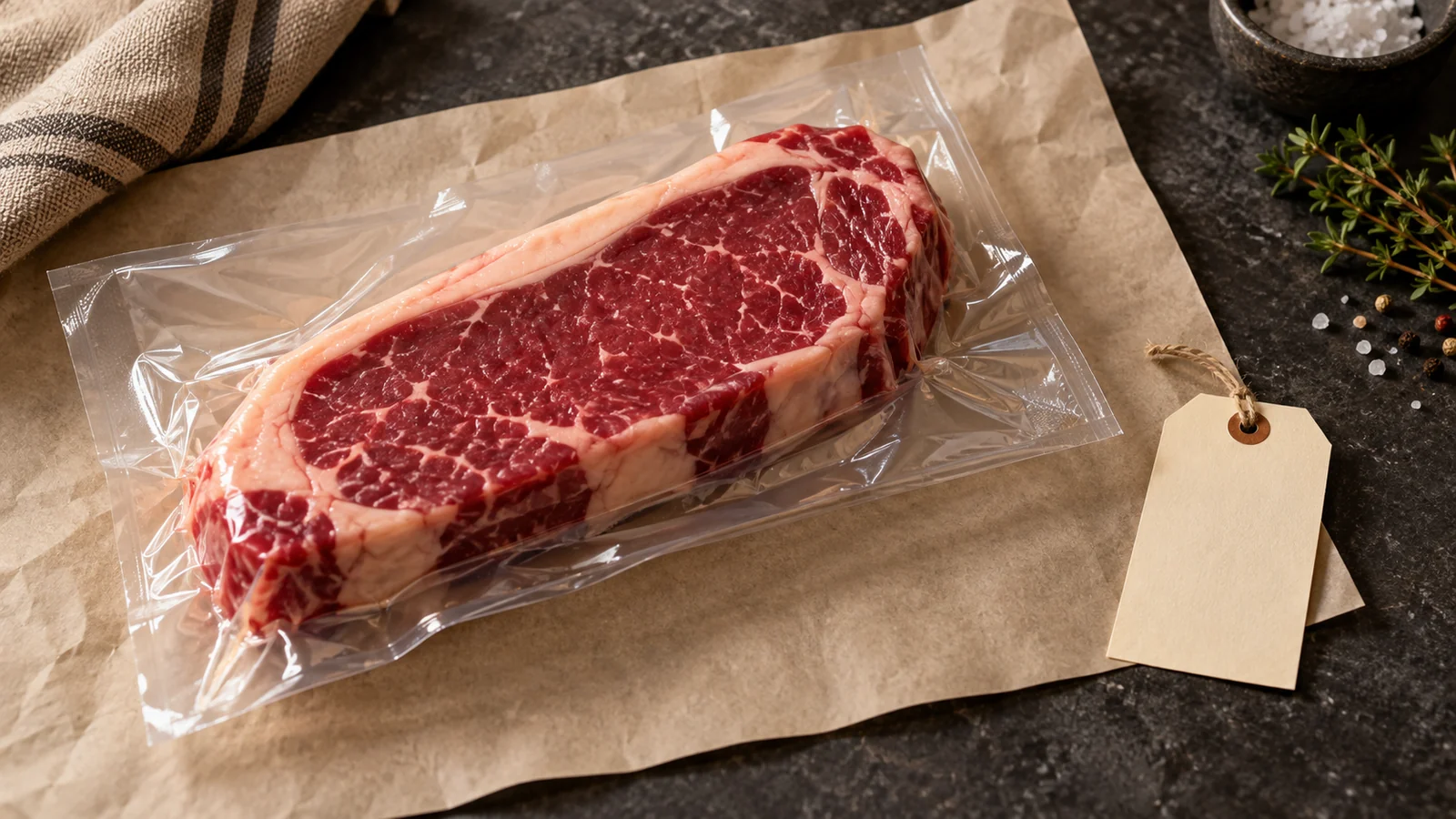
Opening image: AI-generated editorial recreation. It does not show a real product or commercial label.
Turn over a pack of meat and you find names, numbers, dates and perhaps a mark. Everything seems important, but it does not all answer the same question. Before looking for the breed or country of origin, find the line that tells you what food you are buying.
We will read six real labels: five from supermarkets and one from Discarlux. We will follow the journey of a beef cut and learn to distinguish ingredients, dates and quality marks. Each example helps us practise a different question.
Before origin, the food name
The largest word on the pack is not always enough to describe the product. Find its food name, then follow a simple order: what it contains, where it comes from when relevant, how to store it and which date or reference identifies the unit. Breed and marks are interpreted on that basis.
This guide focuses on shopping in Spain and distinguishes beef cuts, minced meat and meat preparations. The photographs document particular packs from different dates: recipes, designs and batches can change. An old image does not assess the product sold today. Later, we compare references across the Americas to guide the same reading process in each country.
Alcampo: following a beef cut’s route
This historical Villa del Monte pack carries the word “escalopes” and the category “añojo”. Further down is the animal’s route. Look at the complete photograph: the country may be visually separated from the establishment name, and a tight crop would lose that information.
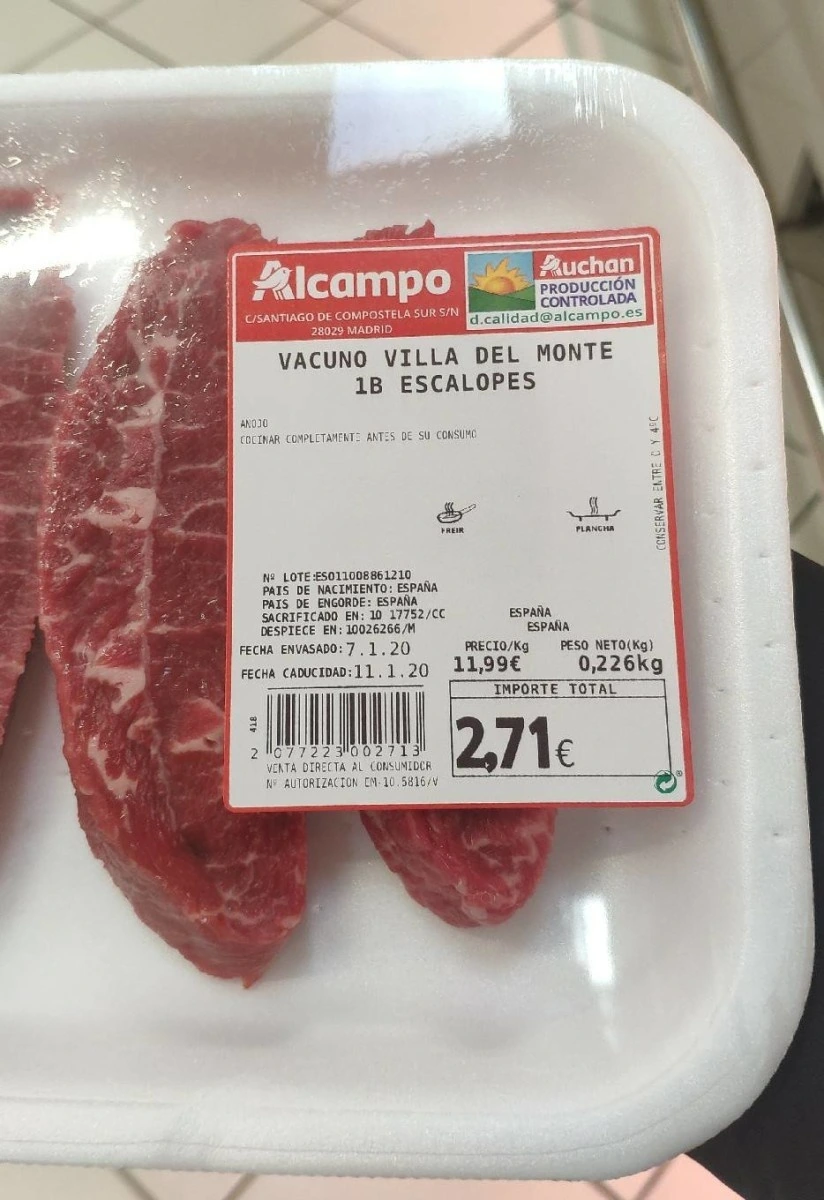
View the original Alcampo label at full size.
- Identify the cut Find the food name. “Escalopes” helps identify its presentation; “añojo” adds different information. Neither is the brand name.
- Follow the route Spain appears for birth and rearing, alongside slaughter and cutting statements and their identifications. Read each stage; the company’s address does not replace that route.
- Identify the unit The reference and dates belong to the photographed pack. They show where to look, not the details of a current pack or how long to store it today.
Example source: Open Food Facts record and photograph. The image retains the pack’s context; no unreadable numbers have been reconstructed.
Origin: the seller’s country does not tell the whole story
A shop being in Spain, or a brand having a Galician name, does not establish where the animal was born. The relevant information distinguishes birth, rearing, slaughter and cutting. A supply chain can cross several countries without automatically being better or worse: it describes a route.
For beef cuts covered by this scheme, labelling includes a code linking the meat to the animal or group of animals, the countries associated with those stages, and the approval numbers of the slaughterhouse and cutting plant. When birth, rearing and slaughter take place in the same country, those three statements can be combined into an origin statement, such as “Origin: Spain”. Cutting is reported separately. Required beef information, Spain’s agriculture ministry.
“Cut in Spain” therefore does not mean “origin Spain”. A health approval number should not be read as a culinary score either. Spain’s consolidated Royal Decree 1698/2003 distinguishes these statements.
Discarlux: one rib steak, two countries on the label
We can now see that journey on a Discarlux beef rib steak. A Madrid address appears at the foot of the label; higher up, the origin fields tell us where each stage took place. Read together, they show how a cut moves from one country to another.
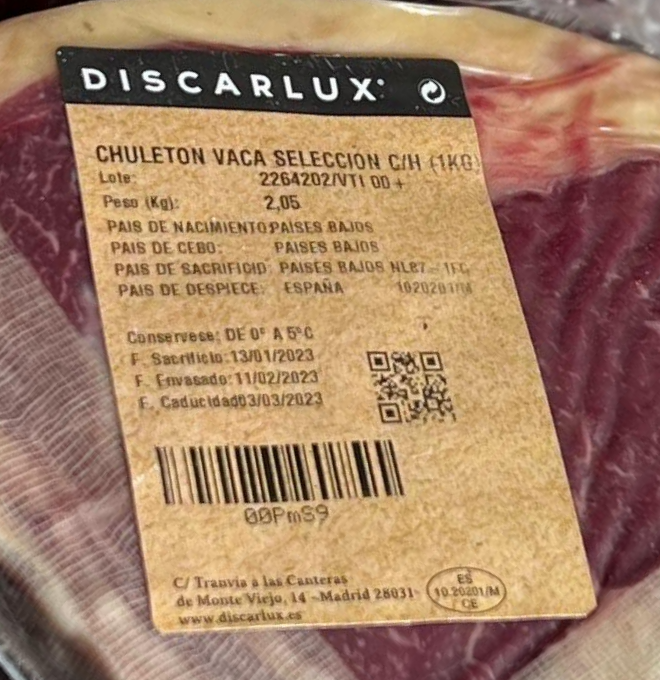
Enlarge the real Discarlux label.
- Read each stage, not just the seller’s country Birth, rearing and slaughter all state the Netherlands. Cutting states Spain. This label shows why cutting meat here does not mean the animal was born and reared here.
- The batch reference and dates belong to that pack The batch reference, weight and dates identify this particular cut. The printed dates are from 2023: we use the pack as a historical example, without attributing its origin, weight or use-by date to a current order.
- “Selection” does not identify a breed The word is part of the commercial name on the label. On its own, it does not tell us the animal’s breed, what it ate or how many days the beef was aged. Those questions need additional information.
Mercadona: 99% does not replace the food name
The top of this detail says “picada de vacuno”, or minced beef. The detail also says “preparado de carne”, meaning meat preparation. That second reading matters: an everyday term such as minced does not by itself establish the food category. The photographed list gives beef (99%), flavouring and antioxidants E-301 and E-331.
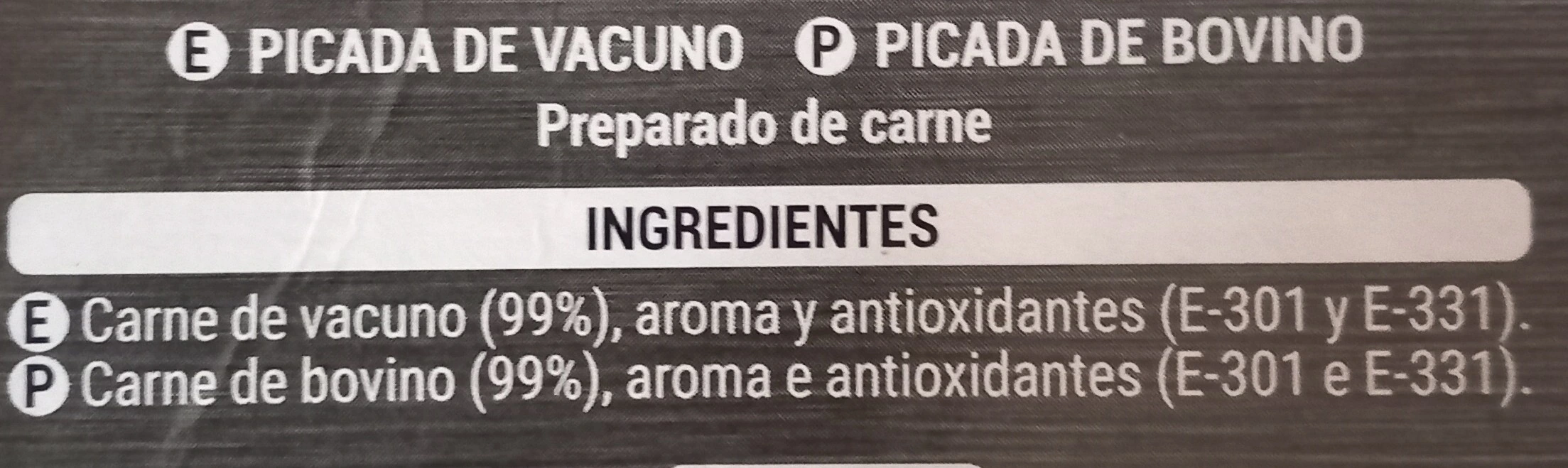
View the original Mercadona label at full size.
- Read the full name Look for “preparado de carne” as well as the prominent text. A high beef percentage does not allow you to relabel it simply as minced meat.
- Separate ingredients and functions Flavouring is part of the declared composition. E-301 and E-331 are described as antioxidants: calling them preservatives would change what this label actually says.
- Do not fill in what the photograph does not show This detail makes the ingredients legible, but does not show the whole pack. Check other sides of the unit you receive for dates, storage and instructions.
Example source: Open Food Facts. This example teaches how to recognise a formulation; it does not compare quality with another retailer’s meat.
Ingredients, animal feed and E numbers
Animal feed is not a generally mandatory field. The ingredients list describes what is in the food you buy; it does not tell you what the animal ate. For information about pasture, feed or a rearing system, look for a separate statement or ask the supplier. Our guide to grass-fed and grain-fed beef explains that question.
An E number identifies an additive; its use depends on the food and the authorised conditions. It is neither a quality score nor, on its own, a sign of danger. E300, for example, is ascorbic acid, known as vitamin C. EFSA explains how additives are assessed. Read the actual composition, especially if you need to avoid a substance, rather than inferring it from appearance or the commercial name.
EU rules allow exceptions to ingredients lists for single-ingredient foods whose name makes the ingredient clear. A cut without a long list is therefore not necessarily missing information. Nutrition declarations also have exceptions for certain unprocessed foods. Where an ingredients list is required, declarable allergens must be emphasised. Regulation 1169/2011.
What to limit, even when it is permitted
A legally compliant label does not, on its own, tell you whether a product is a good choice to eat often. We have consulted dietary recommendations from WHO and AESAN: they advise reducing free sugars, salt and processed meat within a varied diet. These are three useful shopping priorities.
- Added sugars: start with the ingredients Look for terms such as sugar, dextrose or glucose syrup. The “of which sugars” line in the nutrition declaration includes all sugars present: it does not separate added sugars. Compare equivalent products and, when you have a choice, prioritise options without added sugars; consider the rest of the composition too.
- Salt: compare per 100 g and consider your portion When comparing two equivalent products, the salt figure per 100 g is a useful starting point. Choose the lower-salt option and consider how much you will eat. Salt still deserves attention when the ingredients list is short and contains no E numbers.
- Processed meat: the whole product matters It is advisable to reduce products such as chorizo, salami or bacon. A cured meat product labelled “no added nitrites” does not become unprocessed meat or remove the recommendation to limit it. Frequency and quantity still matter, including for fresh red meat.
The World Cancer Research Fund recommends eating very little processed meat, if any. This refers to treatments such as salting, curing, fermentation or smoking. Mincing meat alone does not put it in that category; nor is the legal name “meat preparation” enough to classify every example in this guide.
Some meat products contain nitrites, E249 and E250, or nitrates, E251 and E252. The French agency ANSES recommends reducing their addition as far as reasonably achievable, while maintaining microbiological safety. They serve a preservative function, but their assessment also considers the formation of compounds such as nitrosamines. EFSA has raised concerns about dietary exposure to nitrosamines and their potential to cause cancer.
This specific recommendation does not extend to every additive. Nitrites and nitrates differ from the antioxidants E301 and E331 in the Mercadona example and from the sodium sulphite in the Dia example. To make a better choice, identify the substance and the product; counting E numbers cannot replace that reading.
Carrefour: three messages on one front label
This Carrefour BIO pack combines “preparado de carne picada de vacuno”, “sin conservadores” and “origen España”. The EU organic logo is also visible. These are several statements, not a single combined promise. Each needs its own question.
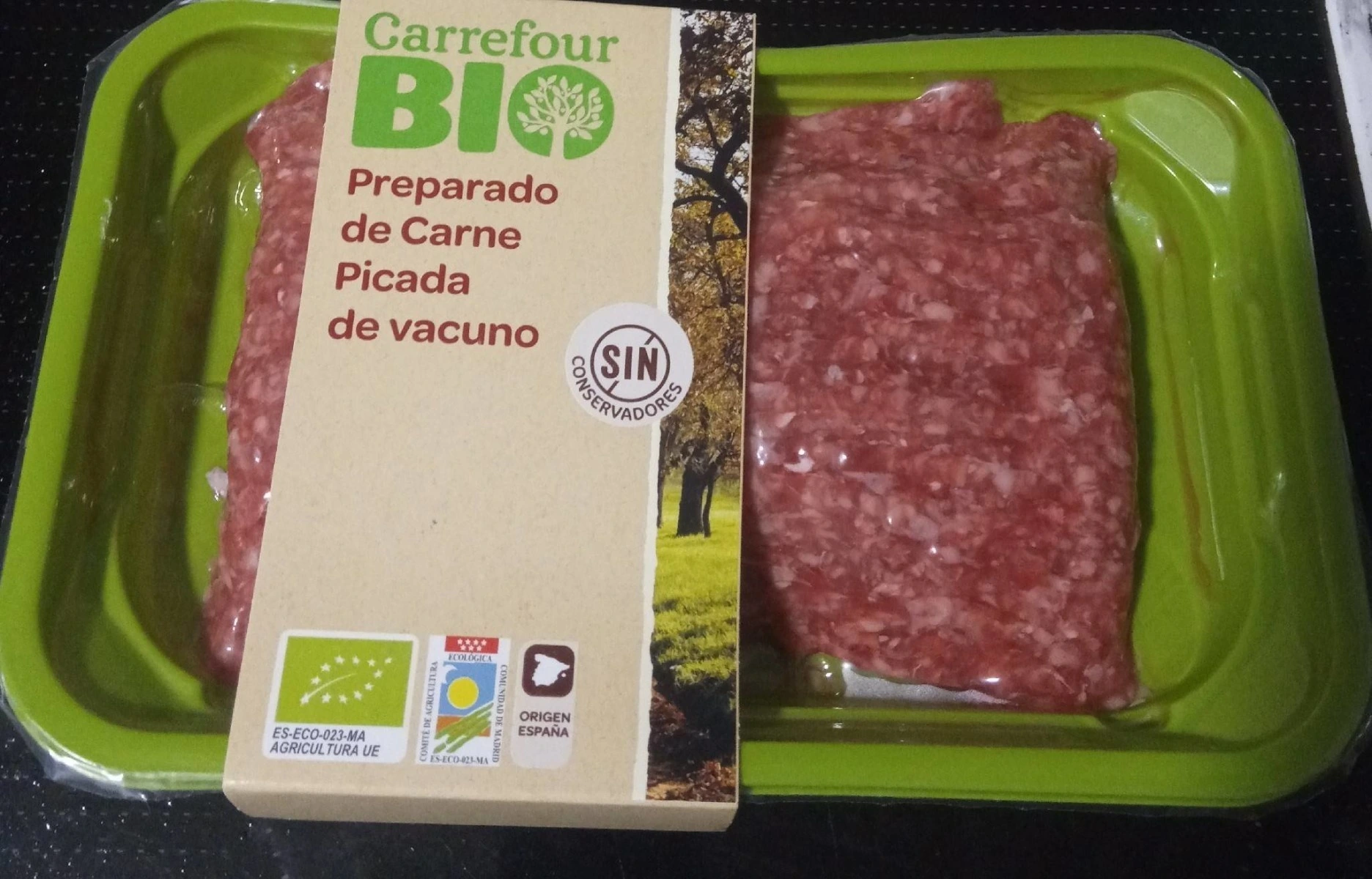
View the original Carrefour label at full size.
- Food name The front identifies a meat preparation. “Sin conservadores” means no preservatives; it does not prove that meat is the only ingredient. Read this pack’s ingredients list.
- Origin and certification “Origen España”, “Agricultura UE” and the organic control code appear separately. Do not use an authority’s code as a substitute for the declared origin.
- The same pack Do not combine this 2019 front with an ingredients list photographed at another time. A changed formulation could make the comparison misleading.
Source: Open Food Facts, original photograph 1.
Dia: composition and a traces warning
This Selección de Dia example is presented as a beef preparation of the burger meat type. It lets us locate the beef percentage, the functions of different additives and a traces warning.
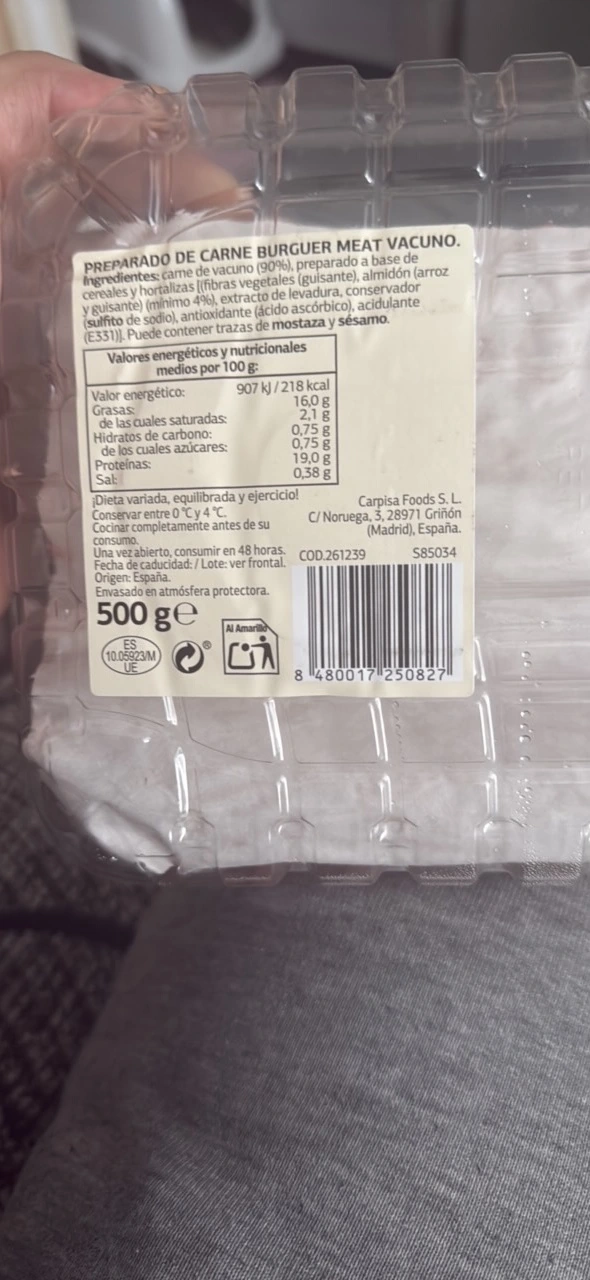
View the original Dia label at full size.
- Composition The list declares beef (90%) and a preservative, sodium sulphite. Its stated function differs from the antioxidants in the Mercadona example. Identifying it helps explain the recipe, not establish a ranking.
- Traces The pack warns of possible traces of mustard and sesame. This is specific to the photographed pack, not every preparation, and should not be confused with a list of deliberately added ingredients.
- How to store it The pack states storage between 0 °C and 4 °C. Follow the instructions and date on the product you receive, not the date in the photograph.
Source: Open Food Facts, reverse-label photograph.
Lidl: separate the marks before interpreting them
This front label from Lidl shows “Origen Pirineos”, “hamburguesa ecológica”, the EU organic leaf and a Welfair mark referring to AENOR. Seeing them together does not make all the messages the same certification, or reveal the side we cannot see.
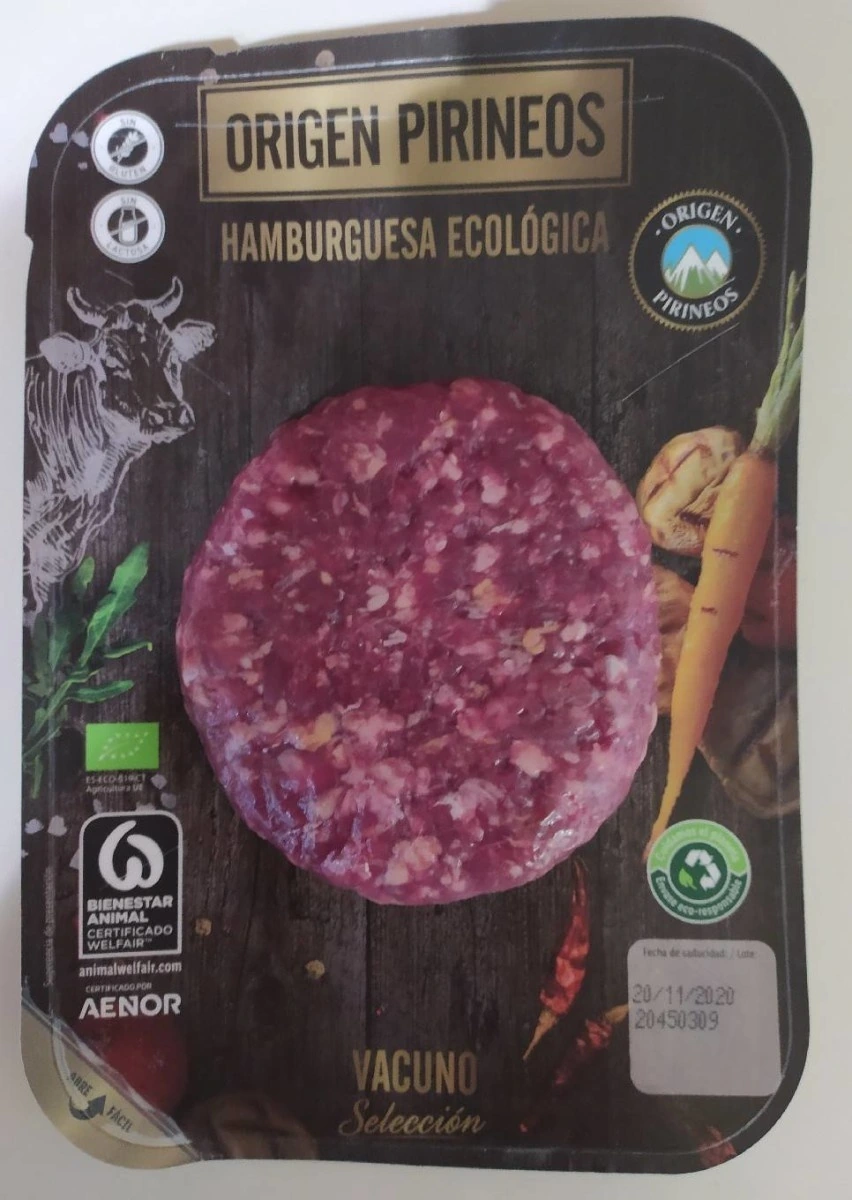
View the original Lidl label at full size.
- Commercial name “Origen Pirineos” is not enough to establish that this is a PGI. Check the exact protected name and its corresponding requirements.
- Organic production The EU leaf and “Agricultura UE” provide a different clue from the commercial name. The small code is not transcribed because it cannot be read confidently in this photograph.
- Welfare The Welfair mark points to a different scheme. Check the system and the relevant product to understand its scope; it is not automatically a breed, an origin or a flavour score.
Source: Open Food Facts, original photograph 6.
Organic beef: what it certifies and why it can cost more
The green leaf seen on the labels identifies a certified production system with environmental, husbandry and animal welfare rules. It may interest you if you want those criteria to inform your purchases. The European Commission explains what the organic logo certifies; its scope is not to guarantee that every product has a superior nutritional profile.
Production conditions, farm conversion and certification checks can influence the price. The Commission describes the requirements of that conversion, while its economic analysis of the sector published in 2023 shows differences in costs and yields across activities and countries. Organic products can therefore cost more, but there is no fixed premium and not every farm has higher costs.
Organic does not mean additive-free: the rules allow certain substances in processed organic foods. An organic burger still calls for a look at ingredients, salt and sugars. The logo tells you how it is produced; composition and frequency of consumption answer different questions.
What changes with the product and how it is sold
For ordinary prepacked food, start with the food name, net quantity, date, storage and responsible operator. Add applicable origin and, where required, ingredients, allergens, percentages and nutrition information. Exemptions matter: not every food needs every statement. Product type and sales format determine how to read them. ACSA guide to mandatory information.
| Situation | The distinction to make |
|---|---|
| Prepacked beef cut | Check the food name, net quantity, date, storage and responsible operator, plus applicable beef origin and reference information. |
| Minced beef | Reference, country of production and slaughter; birth and rearing where these differ from production. Do not copy every steak field. |
| Meat preparation | It does not automatically inherit the beef-cut origin scheme. Composition and declared statements matter. |
| Counter sale or packed on request | Food name, allergens and beef-specific information where applicable, which may be displayed on a sign. A full ingredients or nutrition panel is not automatically required. |
| Retailer-packed for immediate sale | Generally subject to mandatory food information, except mandatory nutrition, with the relevant exemptions. |
| Online prepacked food | Applicable mandatory information must be available before purchase, with exceptions such as the date. |
In hygiene legislation, “fresh meat” can include frozen, vacuum-packed or controlled-atmosphere meat. Do not read it as “never frozen”. See the definitions in Regulation 853/2004; for minced-beef origin provisions, consult Royal Decree 1698/2003.
Spain sets rules for non-prepacked food and certain retailer-packing formats in Royal Decree 126/2015. Do not demand exactly the same format at a counter as on a prepacked tray, or infer that beef information is no longer required.
Online, not everything can wait until delivery. For ordinary prepacked food, applicable mandatory origin information must be available before purchase. Formats covered by Royal Decree 126/2015 have their own exceptions for advance information. AESAN’s distance-selling guide provides context. Asking the seller helps, but does not replace information that must be provided.
If a detail is missing: when to ask
An omission can be legitimate: a single-ingredient cut may not need an ingredients list, and some foods are exempt from nutrition information. Breed and feed are not generally mandatory either. Their absence alone does not establish a breach.
First check every side of the pack or the information available at the counter and online. Distinguish “not visible in this photograph” from “absent from the product”. If applicable mandatory information is still missing, ask the seller; if the issue remains unresolved, contact consumer services. Keep the product reference so you can raise a specific question.
EU, Spain and autonomous communities: where to check
This guide starts with EU rules and the Spanish provisions applying to the product and sales format. Also consult your autonomous community’s consumer information: specific aspects can include language requirements in Catalonia or the conditions of a quality mark.
In Catalonia, the Catalan Consumer Agency states that mandatory labelling and information needed to consume a product must be offered at least in Catalan. Its application must be read alongside Spanish and EU rules, in line with Constitutional Court judgment 88/2017; a partial photograph is not enough to assess compliance. Andalusia’s Consumo Responde provides guidance on specific foods. We have checked these two regional references, not audited all seventeen autonomous communities. A PGI does not replace mandatory labelling.
Shopping in the Americas: shared references, different labels
Changing countries does not change the useful questions to ask of a label, but it does change which answers the law requires. There is no single food-labelling regulation for the entire Americas. International references, regional agreements and national rules work together.
The FAO and WHO Codex Alimentarius provides an international reference. Its standards are voluntary in themselves: they need to be incorporated into legislation to become enforceable. A Codex recommendation therefore does not automatically create an obligation in every supermarket.
Mercosur does share a labelling framework. The Resolution GMC 26/03 requires national incorporation. For foods packaged in the customer’s absence, its general text covers the food name, net contents, origin, lot and date marking, with ingredients and instructions as applicable. Here, origin means the country of production or last substantial transformation; it does not automatically describe the four stages shown on European beef labels.
There are exemptions too: the general framework exempts single-ingredient foods from an ingredients list, and Resolution GMC 46/03 excludes meat in its natural state, chilled or frozen, from its nutrition-labelling scope. Always check the national and product-specific provisions that apply.
Central America has another shared reference: the RTCA 67.01.07:10 covers general labelling of prepackaged foods within its regional scope. It should not be mistaken for a rule for all of Latin America; check its application and the additional rules in the country where you shop.
In North America, sharing a trade agreement does not mean sharing a label. The USMCA, called T-MEC in Mexico, sets commitments concerning each party's regulations. The United States, Canada and Mexico retain their own requirements. These three pointers show why the distinction matters:
- United States Since 1 January 2026, the voluntary “Product of USA” claim on single-ingredient meat regulated by FSIS requires the animal to have been born, raised, slaughtered and processed in the United States. Its voluntary status matters: absence of the claim does not prove non-compliance or, by itself, show that the meat is imported.
- Canada Mandatory information on consumer prepackaged foods usually appears in English and French. Imported meat must identify the country of origin. A raw single-ingredient cut may be exempt from a Nutrition Facts table; that single-ingredient meat exemption does not apply to raw ground meat. The table and front-of-package symbol have different exemptions.
- Mexico NOM-051 regulates prepackaged foods within its scope. Where a nutrition declaration is required, it distinguishes sugars from added sugars. “EXCESO” symbols are nutritional warnings, not origin or quality certificates. The standard excludes bulk sales and food packaged at the point of sale; other rules still apply.
Sources for these differences: USDA-FSIS on Product of USA, CFIA on languages, CFIA on meat and Mexico's NOM-051.
A reading pattern to take to any shop: identify the food, who is responsible for it, its composition where applicable, how to store it and exactly what the stated origin means. When comparing nutrition, check whether figures are per 100 g or per serving. Before treating a missing detail as suspicious, check the country, product and selling format: a valid exemption in one place may not apply in another.
Breed, origin and ageing are different things
Breed does not necessarily identify the country of rearing, and ageing days describe a later process. Ask what ancestry is declared and what supports it when it matters to your purchase.
For more detail, see our guide to Japanese breeds and guide to ageing periods.
A mark needs a name, rules and a scope
When you see a mark, look for its exact name and the requirements it checks. Does it cover the product in front of you, a facility or a production system? Then identify who carries out the checks and how you can consult their scope. The word “certified” without that context leaves questions unanswered. Different marks have different rules.
One specific example is Protected Geographical Indication (PGI) Ternera Gallega. Its system includes animal identification, checks and meat certification. The Regulatory Council explains how guarantee certificates and certification labels identify the covered meat. This is more specific than a Galician landscape on packaging. How Ternera Gallega certifies its meat.
Nor is that PGI the name of a single breed. Its product specification allows particular breeds and crosses. Read what each scheme covers without adding promises about unrelated characteristics. Certification does not choose your cut or recipe for you.
Turn “selection” into a useful question
“Premium”, “selection” or “gourmet” may describe how a business presents its product, but they do not replace specific information. That does not automatically make a claim false. It means you still need to understand what it refers to. Voluntary beef information must be objective, verifiable and understandable under EU Regulation 653/2014.
A cut on which to practise reading
Discarlux’s “Chuleta de lomo alto de vaca selección europea 1 kg aprox.”, a bone-in rib steak of approximately 1 kg, offers a concrete purchase to apply these questions to. Read the current description, confirm the format and availability, and ask about the origin of the piece or batch you would receive. “European selection” does not itself identify a single country.
Carnes Deluxe has a commercial collaboration with Discarlux. Read our editorial transparency policy.
Five checks for your next purchase
- Read the full food name: cut, minced meat or preparation.
- Find the origin information relevant to the product, rather than using the company’s address.
- Check ingredients and allergens where relevant; also compare salt and sugars per 100 g between equivalent products.
- Follow the date and storage instructions on the pack you receive.
- Interpret breed and marks within their scope; ask what you need to make your choice.
A label does not need to promise the flavour before the first bite. It helps when you can distinguish what food you are buying and what information supports your choice.
To complete your choice, continue with how to recognise quality beef and our guide to cut names in Spain and Latin America.
If you are choosing a preparation to cook, continue with our guide to beef for burgers. Here we learn to read the pack; there we make decisions about format and preparation.
About the photographs
The five documentary images come from contributions to Open Food Facts and are reused under CC BY-SA 3.0. The contributing account is credited beside each example. These historical examples teach label reading; they do not establish the current composition of an entire range. Always check the pack you receive. CC BY-SA 3.0 licence terms. The photographs have been converted to a web format without retouching text or data.
The Discarlux photograph was supplied by Carnes Deluxe and is used with permission. It has been framed and rotated to show the label, retaining the original photograph without reconstructing its text. This permission is separate from the licence for the five Open Food Facts photographs.