
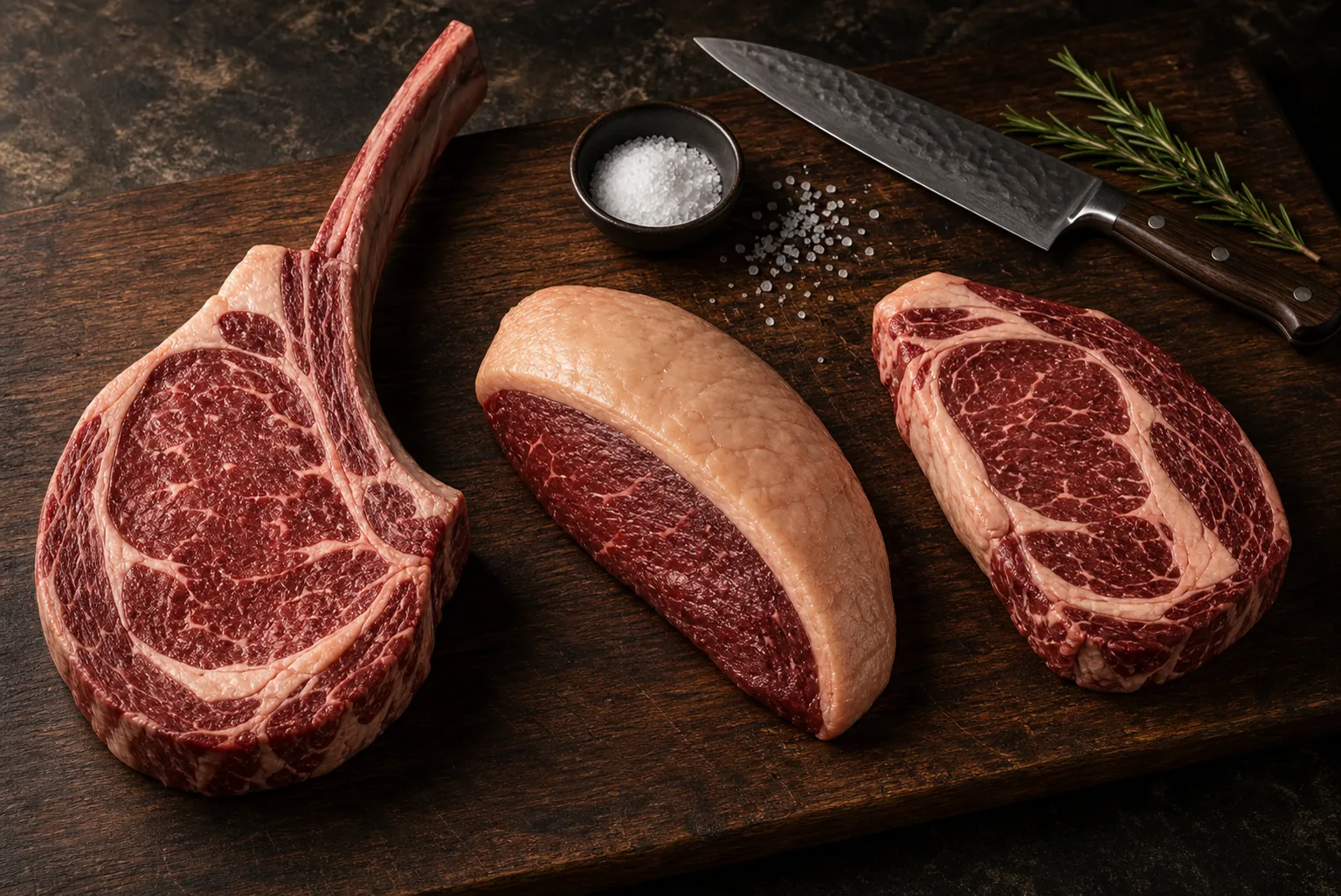
It is a familiar situation: you are planning a special barbecue and three promising names appear. Tomahawk makes an impact, picanha is made for sharing and entrecôte seems the most straightforward option.
None is best in every situation. The format, fat, usual thickness, ease of portioning and attention required during cooking all differ.
The choice becomes easier when you first decide how many people you are cooking for, what equipment you will use and how much control you have over the heat.
A quick choice
For an initial steer, think about the experience you want to serve rather than only the product photograph.
- Tomahawk: for a striking centrepiece when you have enough time and space to control a thick, bone-in steak.
- Picanha: for a shared barbecue where the external fat and the way the beef is sliced play a central role.
- Entrecôte: for easy-to-calculate portions, a more direct cooking process and a first premium-beef purchase without too much ceremony.
What they have in common
All three come from areas valued for grilling or griddling and may offer fat, juiciness and good browning. That does not mean they should be cooked or served in the same way.
When buying online, the name alone tells you little. The weight may include bone or external fat, and two cuts with the same name may have very different thicknesses and yields.
- Check the weight or weight range and the number of pieces.
- Confirm whether it is sold bone-in and how much of the cut the bone represents.
- Look at external fat and marbling without treating them as the same thing.
- Read the supplier's storage and defrosting guidance.
- Consider where the cut will fit: grill, pan, oven and resting surface.
Tomahawk: spectacle with technical demands
A tomahawk is a thick bone-in rib steak with a long section of rib bone left attached. The bone creates its distinctive presentation, but it also makes the steak larger and more awkward to handle than a boneless entrecôte.
It makes sense when you want to bring a whole cut to the table and have enough room to sear it and finish the centre gradually. The outside cannot tell you precisely what is happening close to the bone; with a thick cut, a clean thermometer is more reliable than cutting into it repeatedly.
Before buying, compare the usable weight and ask about the approximate thickness. Its visual impact should not obscure how much beef you will actually serve.
- Choose it when you want a cut to share and can give it close attention.
- Avoid it as a first choice if your grill or pan cannot comfortably accommodate its length.
- Prepare a clean, stable resting area before you carve it.
Picanha: external fat and slicing that shape the experience
Picanha, also called rump cap, is a hindquarter cut with a characteristic fat cap. It can be very rewarding on the barbecue when that fat is used deliberately and the beef is sliced correctly for serving.
It may be cooked whole or in portions, but each format requires different decisions. With a whole piece, an even shape matters; with portions, identify the direction of the grain before cutting and remember that it may change across the cut.
Do not automatically remove the whole fat cap before cooking. Decide how much to retain according to the cut, the method and your diners' preferences.
- Choose it for a shared barbecue and a flavour profile in which the external fat plays a part.
- Ask for it not to be over-trimmed if you want to decide how to prepare it yourself.
- Identify the grain before cooking and check it again when slicing.
Entrecôte: balance and easy portioning
Entrecôte offers a more direct experience: it does not have the tomahawk's long bone and does not require you to manage a whole piece like picanha. Its format makes portions easier to estimate and cooking easier to adapt for each diner.
It is a good introduction to premium beef because you can focus on surface, thickness, fat and doneness without adding too many variables. Even so, entrecôtes vary: check which part of the loin they come from, their thickness and the stated ageing.
When several diners prefer different levels of doneness, cooking separate steaks may be easier than serving one large cut.
- Choose it for clear individual portions and a straightforward cooking process.
- Check the thickness; a front-facing photograph may make it look thicker than it is.
- Adjust the heat to the actual cut rather than following a universal time.
A practical comparison
- For a celebration and a central presentation: tomahawk.
- For a relaxed barbecue and a cut that lends itself to sharing: picanha.
- For individual portions or different levels of doneness: entrecôte.
- For a kitchen with limited space: usually entrecôte before tomahawk.
- For learning to identify and slice against the grain: picanha offers an especially useful lesson.
The recommendation changes if the actual weight, thickness or format does not suit your equipment. Always check the specific product description before applying this general guidance to a purchase.
Three mistakes that undermine the comparison
- Comparing only the price of the piece without checking price per kilogram, bone, fat and yield.
- Choosing for visual impact and then discovering that the cut does not fit the cooking surface.
- Applying the same technique and time to formats with different thicknesses, bones and grain.
Before you buy
- Decide how many people you are serving and whether you want a centrepiece or individual portions.
- Measure the usable space on your grill, griddle, pan or in your oven.
- Compare weight, thickness, bone, fat, ageing and delivery format.
- Read the storage instructions and prepare enough refrigerated space.
- Decide how you will monitor doneness and which tools you will use for carving.
Further reading
- Visual guide to beef cuts
- How to choose a good bone-in rib steak
- Common mistakes when cooking premium beef
Before visiting the shop
Check the available discount and its instructions, then compare the real product details for each cut before choosing.